Showing posts with label Cinematography. Show all posts

Tuesday, 8 March 2016

2nd Rough Cut of the Final Scene

This is the 2nd rough cut of the final scene, where the killer kidnaps the final girl. This is the bit that I edited, where I am still going to put sound on and either detach the audio that is on there now to just work with sound effects and non-diegetic music for there to be created a lot of tension.


In the exam there will be 4 main technical aspects that we need to comment on. These are:
  • Mise en scene
  • Cinematography
  • Sound
  • Editing
In terms of mise-en-scene, the costume of the central protagonist such as her jacket and her tight jeans denote that her age is around 16-17. You can tell that the central protagonist is not the typical character of the usual scream queen. Had it been a scream queen, she would have had blonde hair, ripped jeans or even a skirt and maybe have a handbag or clutch with her. The choice of the central protagonist wearing a concervative high collar T-Shirt, also emphasise the fact that there was a counter-typing by using the final girl and killing her instead of the scream queen.

Also, the costume of the killer waering all black and having his hoodie up around the mask denotes the genre. The mask is very good, because it really emphasises on the horror genre. Throughout the entire film, the audience isn't able to see the mask until the last bit where the killer finally appears on screen. This creates tension, and I intend to work a lot more with non-diegetic music to be able to build up the tension. Furthermore, when looking at the 1st rough cut, which was edited by Jonathan, you can see how our final girl is getting a false scare, by a woman who only wants to return her bible.


In this clip, which I am going to edit as well, I will begin with the non-diegetic music in order for there to be continuity throughout in terms of sound.
Moreover, there is a different ambient sound in every single shot. because we hear Bronwen's shoes going over the street and then you hear a car as well in the background. Due to this, I will loop the sound from the first shot, so that there will be continuity in it and that the sound doesn't change in the different shots. 

The mise-en-scene is very good outside, and the darkness and the natural appearance of the blue tint helps to connote the genre. This location was chosen on purpose because of the very bright lighting that added this specific blue tint as a natural effect. Because it turned out this well, I will be editing the first rough cut, by adding a blue filter when our central protagonist comes out of the church as well.
Another way we could have portrayed our central protagonist as more vulnerable would be to have framed Bronwen on the left or right side in the frame.
There is also some foreshadowing because she is walking towards a less lit space, where it is very dark, which foreshadows that something is going to happen.
Two other angles, that could have been incorporated, would have been a low angle and a dutch angle to make Bronwen appear as more vulnerable.

This shot was done on purpose to foreshadow, how she is going to get kidnapped. In thsi shot, she is a dark silhouette, which connotes that she is practically already gone.

Friday, 4 March 2016

Exam Practice 2: Representation of sexuality and race


In terms of mise-en-scene there are a lot of cables, computers and bright lights to emphasise on the laboratory setting. This creates a sci-fi feeling, which really helps to establish the genre. The low key lighting is especially helping to create the dark and mysterious atmosphere.

When listening to the music, there is a lot of non-diegetic music. The non-diegetic sounds of water dripping in the basement and the non-diegetic dramatic music, helps to establish the genre and creates a certain tension. Throughout the whole clip the music is very ominous and then all of a sudden when they stop kissing, it becomes even more dark.

When looking into cinematography, the beginning of the clip starts with a medium close-up, which gives us a real focus on her face and characteristics. 


When denoting her appearance, the audience would pick up on her black hair. Had she been portrayed as the stereotypical western beauty, she would have been blonde and would have worn more make-up such as a red lipstick. In this scene, she wears a light blush and a very neutral lipstick.
Furthermore, the framing in the first shot focuses on the character, but it also establishes the narrative enigma, because it doesn't suggest where the location is. During the dialogue, there is a shot reverse-shot which keeps returning back to the woman with the black hair. Through this, the audience knows that she is he main character and the central protagonist is established. According to Propp's character archetype theory, she would be the "Hero".

From that shot there is a reverse-shot to the antagonist, where we see her in a medium close-up.


Her lack of make-up, messy hair and color of the hair, her innocence is portrayed.


When our central protagonist sees, how the girl is suffering, she looks like she is in pain and the audience is being positioned to empathise with the central protagonist.

When looking into representation, we are positioned to identify ourselves with the central protagonist, because the shot keeps going back to her. Due to the fact that our central protagonist is empathising and feeling sorry for the antagonist, the audience automatically does the same.
There is a stereotype created of the girl with the lighter hair as the female victim. There is also created a counter-type for the central protagonist, because she is helping the girl. In other films, helping a female would usually be done by a male actor. It has become normative in society and has become a stereotype that men are strong and are always the ones who help a female in need of help.

This medium two-shot below is very tightly framed, leaving no speace between the two character. This shot is connoting that there is a bond between the two characters.


The media language chosen of this slight high angle and the medium two-shot, signifies that they are both vulnerable and that they are both in danger.

During this small clip, there are soft and slow piano tunes. This has connotations of sadness and it really anchors the relationship between the two characters.


It can be interpreted to be romantic and it fits well with all the other signifiers that have been encoded into this text. 

This shot shows how the two characters are staring into eachothers eyes and grabbing eachother so hard around eachothers arms. This connotes that there is a romantic feeling between the two of them. 


The welsh accent used in this program, would be suited for a British or Welsh primary audience. This shows that this show could not be shown in America. Due to this, the show is not gaining a large amount of profit. Hence, it doesn't support the Gant Rule.
When the male character is observing the two girls in the basement and starts to record it as well, it could be denoted as male gaze features. The shot is cutting from the two girls to the male character.
    "The male gaze is a concept coined by feminist film critic Laura Mulvey. It refers to the way visual arts are structured around a masculine viewer. It describes the tendency in visual culture to depict the world and women from a masculine point of view and in terms of men's attitudes."
When the central protagonist is seen behind the glass, there is a use of intertextuality, because it is similar to a scene in "The Silence of the Lambs" from 1991 by Jonathan Demme.

This intertextuality, is used to appeal to the secondary target audience, which is parents and older people, because they might have seen the movie. The younger audience on the other hand, might not understand the reference.  


Stuart Hall, stated that semiotics had a lot of limitations as it was assumed that all of the reading resided to the only in the text. He argued that meaning resides in the audience as well and that the different people react to different things in different ways. 

When looking into semiotics and it's syntatic level, the dominant elements on screen are the 2 girls. Since, the antagonist keeps pushing her away, the overall effects is that we begin to feel sorry for our central protagonist. 

When just focusing on the representational level, we can see that our central protagonist has an interest in women and has feelings for the antagonist, alien. She is the one that keeps wanting to kiss her, despite the fact that the antagonist keeps pushing her away. This denotes, that she has a strong interest in her, because she doesn't stop immediately. In the scene that I analysed from 1:30 to 2:00 min, the camera is nearly always creating a medium close-up or close-up, so that the audience can clearly see the emotions of both of them. 

The editing in this clip is continuity editing, which is very linear. There are no jump-cuts in the scene.

Thursday, 28 January 2016

Practice Shoot 1

WHAT I HAVE LEARNED + WHAT I CAN APPLY

We decided to do a practice shoot, which was useful to know specifically how to work with the different functions of the camera, what to do in terms of cinematography and how to decide when to do hand-held footage and when to do the shots with the tri-pod.


From this practice shoot, we learned a lot of different things. This shoot is also the reason for why we changed our idea.

On my blog, I did a link list for every single time we changed our idea. The initial idea of group pitch 1, was to have the girl being kidnapped in a dark parking lot under a huge shopping mall. The first scene would be filmed in the shopping mall, which is the bit that you see here.


The shot that we did first of her shoes and then another pair of shoes was used at first to denote that the killer was moving closer and closer. However, we noticed very quickly that our audience got confused with which shoes were which because they were both black and white. The shots were also very short, so for some it turned out to be confusing whether it was another pair of shoes or just the same.
Furthermore we discovered that it was really hard to work with the ambient sound, since there was such a loud diegetic sound within the mall. We used several different camera angles, such as establishing shots, mid-shots, close-ups etc., which ofcourse than also created a different ambient sound in every single shot.

Moreover, there was a problem with continuity, since we would need to film in the mall over some days in order to finish all the scenes. This would mean that there would be different people in every shot and that we would create a problem with continuity.

Also, we thought it would be really hard to create tension in a mall. We would have had to work a lot more with non-diegetic soundtrack and thought that even if it would be good it would still be hard to emphasise on the horror genre. In the coursework we have now, we used a good location and especially at the ed we got to build up quite a lot of tension.

What we did learn through this practice shoot was how to use the SONY camera, in terms of zoom, shallow and deep focus. We got to practice a bit on how to retach and detach it from the tri-pod, which was also very useful so that we wouldn't lose time with that at our real shoot.
Lastly, we learned how we should always come together so that everyone would suggest which camera angles to use. This allowed us to have a great shot variety.

Monday, 4 January 2016

Evaluation - Tyrannosir Swede

After finishing our swede, we screened it in class and analysed what was good and what could have been done better in terms of editing and filming.

In the first scene when Kristian (Hugh) is kicked out of the restaurant and calls for his dog "Fanten", the pace of the cutting was too fast-paced and there is a loss of continuity, since we filmed Kristian in different positions and there wasn't a smooth transition in the movie.

Also due to the fact that Kristian changed positions and we filmed from different angles, the ambient sound changed and the microphone picked up the wind from different angles and therefore there were different diegetic sounds. Furthermore, there is an ambient sound of church bells before Kristian says dispose and the do is kicked. In this case, over-dubbing is very useful and can be used to record the audio and recreate it on the video. However, one could also record an amount of continous ambient sounds, which can then be added to the clips so that continuity is established.

In terms of shot variety, we haven't used many different shots. During the scene where Kristian is calling for Fanten, we have only filmed medium close-ups, close-ups and mid-shots.


We should have added different shots to create an effect. For example, the kicking of the dog should have been in slow-motion and should have been filmed from different positions. In addition, there could have been added a non-diegetic dramatic music, since this is a very important and sad scene in the real Tyrannosaur movie from Warp.
Moreover, the angle's didn't change either, so there wasn't any change or dramatic effect.
We could have done a black and white effect when the dog hits the ground, to add a dramatic effect and show that it has died. Also, when he kicks the dog, there are a lot of non intentional jump-cuts, which create a lack of continuity.
We should have done more coverage, meaning that we should have looked for different material. For example, we could have done an extreme close-up of an object such as the champagne glass.

In the funeral scene, the editing could have gone better, if we would have gone from the cross and book upwards instead of downwards from my (preacher) face to the book and the cross.
Also, we should have done an extreme close-up on the hand, to really emphasise on the cross and the sad times of a funeral.

However, in terms of cinematography, there is a shallow field of focus of the me (preacher), which in this case works well, because there is nothing important in the background in terms of context. The entire focus is on the funeral.

When the camera pans to the right, to look at all the characters, one character is looking into the camera. In this case, there should have been more directing to tell her that she shouldn't look into the camera. It is important to always give clear and precise direction and instruction of how the director wants the actors to look and act.

Furthermore, the funeral scene was edited, so that it kept returning to the master shot to create continuity. This is good editing, because if you don't do it, you will get unintentional jump cuts, that will create a lack of continuity.

In terms of cinematography there is shaky footage. At some points, it is appropriate with shaky footage such as a chasing scene. However, in the case it would have been better with a tripod, since the goal is to make the film realistic and shaky footage makes it unrealistic.

The second last shot of the funeral scene of Kristian is an extreme-close-up , which is very useful because it is supposed to show emotion.


At the beginning of the music shop scene, we could have done crosscutting between Adel and the door handle opening. This would have been useful to show Adel's exact reactions and emotions when the door handle opens. It would have been useful to have had the very first shot of the music scene on the door handle. This would have been a useful use of foreshadowing to show the audience that it will open and something is about to happen.
The different shots and the framing of Kristian behind the music instruments created a good sense of continuity.


Tuesday, 29 September 2015

Film opening 5: Bridge to Terabithia (2007)

Director: Gabor Csupo

Release Date: 16th of February 2007 (USA)

Actors: Josh Hutcherson, AnnaSophia Robb, Zooey Deschanel

Production companies: Walden media, Hal Lieberman Company, Lauren Levine Productions Inc.

Genre: Adventure, Drama, Family, Fantasy

Budget: $17.000.000 (estimated)


The opening scene is an establishing shot of a house and a car and a greenhouse. An establishing shot is very often used by the director in order to give the audience a general impression and view of the setting.


The establishing shot keeps being on screen until there is a man coming out of the house. The camera zooms in a bit while the man moves closer to the car. Since, this is the first character we see in this setting, the audience could assume that this is one of the main character's.

The title comes up on screen as the camera zooms in on the house. It says "Bridge to Terabithia". As Terabithia sounds very exotic and imaginative it is like a contrast to the house since that looks old and simple.


Furthermore, the camera zooms in on a particular window which connotes that something is about to happen since there is so much focus on it.
All of a sudden, someone turns on the light in the room so the audience sees a shape of someone looking out of the window.

The following shot is a point-of-view shot of a young boy looking out of the window as the car is pulling out of the driveway.


The audience knows that the car is seen from a boy's point of view, since it is shot from a high angle of the window but also since the next shot is a close-up from the side of the boy looking out the window.


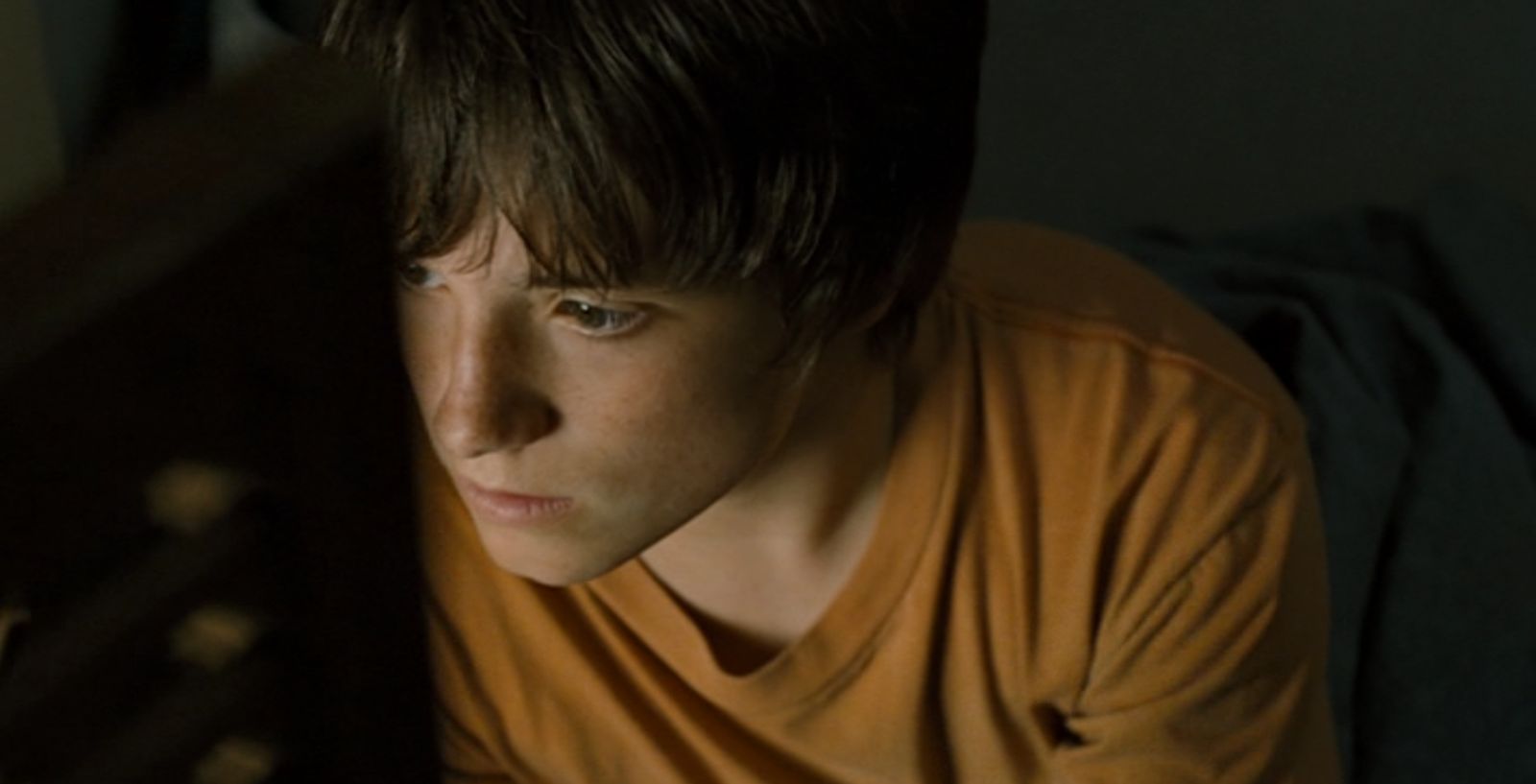
After the boy has seen the car drive away, the next shot we see is a long shot of him running out of the door and along a path outside of the house. Since the boy was waiting with running until the car was gone, the audience could interpret that the man doesn't like it when he is running or the boy doesn't want to let anyone know that he does run. As the title of the actor's name comes up on screen when e begins to run, the audience knows that he will probably be one of the main character's in the movie.

The next shot is an extreme close-up shot of a hand holding a pencil and drawing. The camera keeps fading or making a straight cut between the boy running and the drawings. Through this, the audience can interpret that it is the boy drawing.


As the cuts keep switching between the shot of drawing and the shots of the boy running, the character of the boy is being established, denoting that he enjoys drawing, but also that he loves running. The audience knows that he loves running, since he runs through rain, which signifies that he doesn't care about what weather it is. He just has to run.


As mentioned before, the shots keep switching between a long shot of the boy running and a close-up of the drawings he makes. The next two shots are close-ups of his drawings. In these shots, the audience can see that they are very unusual drawings of humans and animals that live in his imagination. This as well established the boy's character, by letting the auidence know that he has a very vivid imagination.


In addition, the second picture is a close-up of his drawing being "alive", again this emphasises that he has a vivid imagination and fantasy and could maybe even suggest that he considers himself to live in this other world that he creates.

As you see, the next picture is a medium close-up of his face. Very often these eye-level and close-up shots are used to let the audience put themselves in his position.


The next three shots are close-up pictures of his drawings. As mentioned above, he is drawing creatures that don't exist in reality. Furthermore he is drawing landscapes and a castle. This again emphasises that he has a vivid imagination but also that he is creating and maybe even living in his own world.


This can connote that he wants to escape his real life and feels safer in his own fantasy. The audience will later find out that the boy might actually be trying to escape his real life, since his family is poor and he doesn't have many friends.

After his long run, we can see him fixing some tape on his shoes on the front porch of their house. He then takes the shoes of when he enters the house, where there is a close-up of his shoes.


The shoes are very dirty and broken since he needs to put tape around them. This denotes that the family is poor and that he can't afford a new pair of shoes.

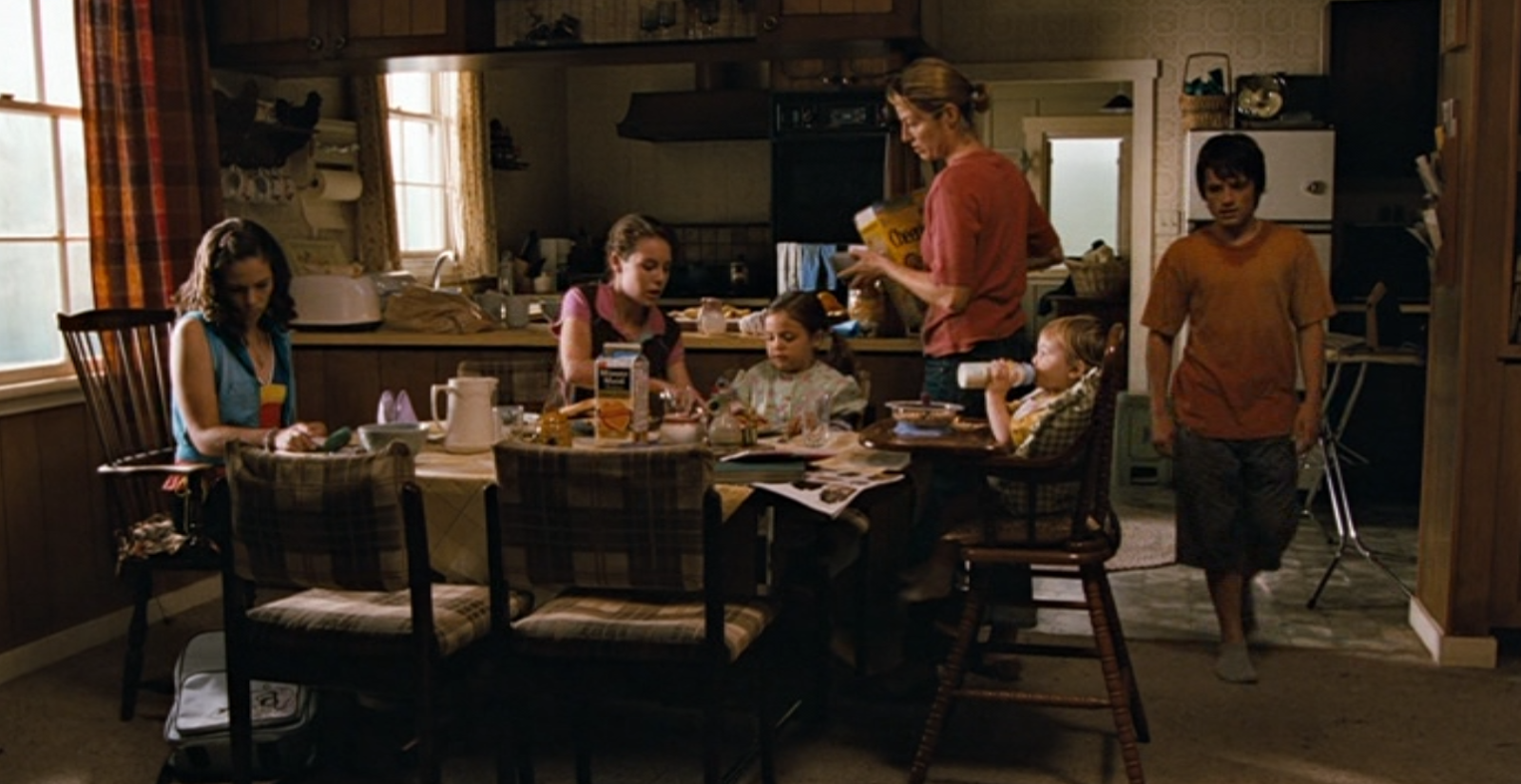
The boy then enters the house, where there is a long shot created of a kitchen with four children and probably his mother around the dining table. The mise-en-scene of the old furniture and the many children again emphasises that the family doesn't have much money. In addition, the audience can interpret that the mother isn't working since there is a baby sitting at the table, which could signifie that she probably takes care of all the children at home.


When the man we saw from the first shot comes into the house, we find out that he is the boy's dad.
This shot is mid-shot of the boy and his father. The boy looks full of disappointment, since his mother has just told him that she threw his shoes in the bin. Moreover, he tells his father that there is a race in school on that day and that he can't run without his sneakers. The fact that he can't run without his sneakers, denotes that he most likely only has that one pair of shoes. Again, this emphasises on the family being poor.


His father says that they need to buy him some new sneakers, whereupon the mother pulls him aside and tells him that they don't have the money for it. This again confirms to the audience that the family is quite poor.


The very last shot, is a medium close-up of the boy looking disappointed since he does know that they don't have the money. Lastly, this again proves our idea about the fact that he wants to escape into his own world since he doesn't like the way that his own life is going.

Throughout this entire film opening, there aren't many sounds except for the non-diegetic music in the background when he is out for a run.

This song is called "Keep your mind wide open" by AnnaSophia Robb, and contributes to the idea of the boy having a wide and vivid imagination.

During the film opening, the media producer uses fading and straight cuts. These editing strategy was used on purpose by the media producer, to show the audience the comparison of his imaginative world and his real world.


Thursday, 24 September 2015

Film opening 4: Bridget Jones's Diary (2001)

Director: Sharon Maguire

Release date: 13th of April 2001 (USA)

Actors: Renee Zellweger, Colin Firth, Hugh Grant

Production companies: Universal pictures, Studio Canal, Miramax Films, Working Title


The very first shot we see is a long shot of a woman (later known as Bridget) walking through the snow. The camera is following her walking down the street though a tracking shot so that there is created a mid-shot of her.


When these shots appear there is a female voice over in the background establishing the first person narrative. She is saying:

" It all began on New Years day... on my 32nd year of being single. Once again, I found myself on my own and going to my mother's annual turkey curry buffet. Every year, she tries to fix me up with some busy-haired, middle-aged bore and I feared this year would be no exception."

This also helps the audience to establish a setting by knowing that it is New Years day. In addition, the character and genre are being established, due to what she is saying. Furthermore, there is a contrast since she mentions being single while there is a couple walking around and hugging each other in the background.


After this, the shot dissolves into an establishing shot of a graveyard, cottages and rolling hills in the back. This creates a very idyllic setting of the countryside.


When she again walks up to a cottages the garden is very pruned and again this emphasises how pretty and idyllic the countryside is. When walking up to the door there is an over-the-shoulder shot created when her mother opens the door.


The minute the mother opens the door there is a non-diegetic sound named "Magic Moments" by Perry Como. This song connotes that Bridget's mother has an eccentric and silly personality. There is also an intertextuality created since this song is part of a Christmas candy advert and therefore reinforces that it is Christmas.

This shot is an is a dutch angle in order to give the affect that the audience is observing from the staircase.


After entering the house, there is a dialogue between Bridget and her mother creating shot, reverse shots from both the mother's and Bridget's perspective.


During the time that Bridget is talking to her mother, the voice over keeps coming back in between conversations.
After having spoken for a minute or two Bridget's mother tells her to run upstairs and put on some other clothes.


On her way up, there is again an establishing shot with the light tilt, creating a Dutch angle, also denoting the sign of resignation on Bridget's face.

The next shot is a mid-shot of Bridget in the clothes her mother had put out for her. She is peering around the corner.

Friday, 18 September 2015

Film opening 3: Love Actually (2003)

Director: Richard Curtis

Actors: Hugh Grant, Bill Nighy, Colin Firth, Emma Thompson, Keira Knightley, Liam Neeson

Production companies: Universal Pictures, Studio Canal, Working Title

Genre: Comedy, Drama, Romance

Budget: $45.000.000 (estimated)


The opening scene is in slow motion and begins with a pan shot from 42 seconds to 55 seconds where there is a shallow focus on a woman with a backpack on her back. The pan shot follows her until she reaches a man who then kisses her, while the camera is zooming in on them. The mise-en-scene of her and the greeting in the airport denotes that she could have been on a long backpacking trip and that she hasn't seen the man for a very long time. Meanwhile there is a non-diegetic sound of very slow music in the background. Moreover, the mise-en-scene immediately helps the audience to establish a setting.


At 55 seconds there is a scene in slow motion where the camera zooms out creating a mid-shot of a woman opening her arms at 56 seconds.


At 58 seconds there follows a shot where she embraces a small girl with braces, big glasses and a bow in her hair. The entire mise-en-scene and the way she has been dressed, is used to emphasise on her youth.
Meanwhile the camera is zooming in again creating shallow focus and establishing a close-up of the girl hugging the woma. This close-up focuses on the girl's face and wants to emphasise on how happy she looks, but also show the audience the relationship between mother and daughter.


All of a sudden, there is a male voice over, that says the following:

"Whenever I get gloomy with the state of the world, I think about the arrivals gate at Heathrow Airport. General opinion's starting to make out that we live in a world of hatred and greed, but I don't see that. It seems to me that love is everywhere. Often, it's not particularly dignified or newsworthy, but ir's always there - fathers and sons, mothers and daughters, husbands and wives, boyfriends, girlfriends, old friends. When the planes hit the Twin Towers, as far as I know, none of the phone calls from the people on board were messages of hate or revenge - they were all messages of  love. If you look for it, I've got a sneaky feeling you'll find that love actually is all around"

When the voice over hinted that the camera shots were from Heathrow Airport, we looked up whether they had been staged or not. It turned out that the director had decided to hide camera's at the arrival gate for a week in order to catch real emotions of people from all around the world on camera. We found out that after filming them they asked the people for their consent to add them to the movie.

During the time from 1.04 seconds to 1.53 seconds where the voice over keeps speaking there are several close-ups of many different people. These are all in slow motion. In addition the voice over is linked to what the audience is seeing on screen.

For example when the voice over is saying "fathers and sons", this is the camera shot that comes up:


And when he is saying "mothers and daughters":


And when he says "old friends":


Each and everyone of these shots is a medium close-up in shallow focus being shown in slow motion, just like every other picture we see in the first 2 minutes. In addition, the voice over creates an interlink between what he says an what the audience sees throughout the different camera shots. Furthermore, the speech of the voice over is meant to create an introduction to the movie and hint to the audience what it will be about. Throughout his entire speech the voice over keeps repeating the word "love" and keeps ellaborating on it by also referring to the terrible tragedy "9/11" that happened in America.

The last cut before the film jumps to another scene, is a shot of three people embracing eachother. This shot is again a medium close-up shown in slow motion.


The words "love actually is all around" show up the second the voice over says the exact same words. As the name of the movie is love actually, we could interpret that it was a certain word play that the director wanted the audience to link with the title. However, it was also a very clear and strong denotation that the movie would be about love.

In the next scene, there is a man singing the song "Love is all around". This is seen as an intertextuality since this song also emphasises on the word love and what the voice over has just said.


The mise-en-scene is in a music studio with a man singing together with his back-up vocalists. There is the diegetic-sound of the music he has to sing too. The entire scene is shown from an eye-level perspective. Through this shot the audience is involved and the director let's the audience feel as if they are part of the movie.
This entire setting is used to introduce the audience to one of the main character's. You can tell that he is a main character, since the camera is always focusing on him with shallow focus, followed by a master shot in deep focus of the entire music studio and the back-up vocalists.
In addition, there is a panning shot around the lead singer in order to show the audience the character from different angles and again introduce him as one of the main character's.
Lastly, we can see that all the names of the actor's playing in the film (such as the two names on the shots above) have their first letter written in red. This could again be a clue given from the director that the movie will be about love since red is the colour of love.