Tuesday, 26 April 2016

EVALUATION QUESTION 4 - Technologies

"How did you integrate technologies - software, hardware and online - in this project?"

Throughout this entire year we have used different kinds of software and hardware to work with.

The software are all the programs that we used to create our film and to work together, whereas hardware are the actual computers, cameras and technologies we have used.

Hardware:

Camera - SONY A58

During this year, we have used a SONY A58 camera, together with other tools. 
Before starting the media course this year, I had already had some experience with a Canon EOS Camera. I have always been interested in photography and filming. When I was younger, I used to create some small films, using iMovie, with recordings I had done during a vacation for example. 
Due to this, I already knew how to use the different aspects of this camera. The SONY A58, films in a very good quality and therefore it allowed us to play around with focus, when for example creating a deep focus when filming the matches in the church.

As you can see in this screenshot, it is very focused on the candles and the light. We did these close-ups of candles and matches to denote her religious character. 


SD Card

During this entire year, we used Bronwen's 8GB SD Card.
After some guidance, I became very confident on how to transfer data from this to my MacBook.
The one thing I would change for next year, would be to firstly have an extra SD card with us everytime or an SD card with a much bigger amount of GB. During filming we experienced that there wasn't anymore space on the SD card a lot of times so that we always had to put it on my MacBook or Jon's before being able to continue filming. This really took away a lot of time that we could have spent on filming instead. Furthermore, I would for next year always double save the footage by using a portable hardrive, rather than just saving the footage on the MacBook.

Tripod


The tripod is a very simple but vital piece of equipment when filming. It allows the shots to be steady rather than having shaky footage throughout your film. At the beginning of the year we had an unsteady Cullmann CB6 Tripod, which wasn't very good, because it didn't keep the camera still. Whereas in December, we got new Tripods delivered to our school, called Mantona Scout. These were much better and were therefore the ones that we used for the rest of the year. 
It wasn't difficult to use and therefore I quickly got the understanding of how to use it. There were a few shots, such as the killer observing Bronwen from behind the wall in a final scene, where we filmed hand-held rather than using the tripod. However, this was only done to denote that it was the killer's point of view.

Fujitsu PC


Throughout this year I have taken a multiplatform approach using Windows PC's, Smartphones and my MacBook. At the beginning of the year I used the Fujitsu PC's that we have available in school. I didn't have my laptop yet and so I did my research and editing of preliminary exercises with this computer. We did not have Final Cut Pro X on the Fujitsu computers, so we used Pinnacle to edit our preliminary exercises


Smartphone

For this coursework I have used my iPhone 6 and my previous iPhone 5 to film audience feedback in the class and communicate with Bronwen and Jonathan over Facebook and E-Mail. The audience feedback didn't have to be high quality, and therefore a smartphone was enough to record this with. Furthermore, I used my iPhone to record a video with max, who created our soundtrack together with me. He explained, which programs he used, since he has a lot of experience with producing music.
When explaining the software we used further down, I will embed the video I recorded of him. 


MacBook Retina

Throughout this year, I have used my MacBook Retina, to work on in class. At the beginning of the year, I did not have my laptop yet, so I worked on the Fujitsu PC's that we have available in school. By having done a multiplatform approach, I  achieved a portable workflow with the use of my Mac. 
I have used several programs and websites on it, such as Final Cut Pro X, which I will be discussing in the software part. 


Software: 


Soundcloud


I used soundcloud, to create some of my podcasts for my Evaluation Questions and end of year summaries. It was very easy to record and upload a podcast, since souncloud has a function, where you can record on their website. I thought, it wouldn't be a good quality, because of the fact that it needs to record over the built-in microphones. However, I decided to try it out and it ended up recording a good voice quality. Below you can see a quick screen recording of how to upload something to soundcloud


Facebook 

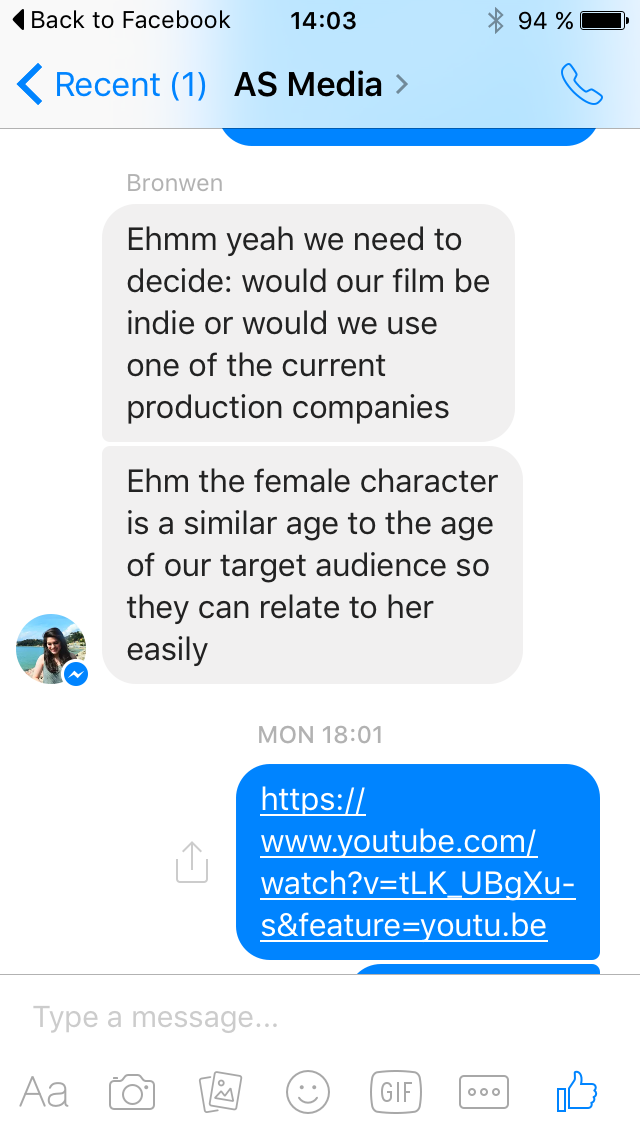
We used Facebook, where we had created a group chat "AS Media" at the beginning of the schoolyear. This chat has been very useful to plan and agree on when and where we are meeting, share information, send each other YouTube links and ask any questions that any one was insecure about. 


Google Drive


Next to Facebook, we also used Google Drive quite a lot, where we created a shared drive, in which we uploaded our pitches and some of the footage that we needed to share. This was very useful for us, since sometime someone within our group  was sick and had all the footage or videos that the other ones were then not able to use. Therefore we decided at some point to create this drive so that we would all have the same footage and not get any difficulties if someone was sick. 

YouTube 

At the beginning of the year, we all created our individual YouTube Channel. I named mine Sophie's Channel, where I have uploaded all of my work such as Rough Cuts, Screen Recordings, Audience  Feedback etc. Creating a YouTube channel, allowed us to quickly embed videos onto our blogs, rather than uploading a video by using blogger's "insert a video" button. 


Final Cut Pro X

This software is what we have used to edit our entire coursework. As mentioned before, I had worked a bit with iMovie before so I knew a bit about editing already. However, I had never used Final Cut Pro X yet, so it took me a bit to figure out the many different tools of this software programme.

Ofcourse I had to start somewhere and therefore I started with the basic tools, such as the blade, range selection, zoom and other select tools.
To make it quicker to use the tools rather than the mouse, I learned to use the keys, such as for example "B", which moved you to the blade tool.

After having mastered the basic tools such as the ones you can see in the picture on the left I moves on to more complex tools so that I could  do a lot more when editing. I learned about working with special effects, sound effects and adding titles.
In our movie we have for example worked with special effects such as the one called "Bad TV", which we used in the beginning of the basement scene so that it would look more creepy. The Bad TV effect was actually inspired from movies such as "Poltergeist" and "Saw". Especially in our rough cut scene in the basement, where we had used a red lighting this effect looked good and made the scene appear more ominous.


We also used another effect such as the "Blue Tint" for the final scene, which I edited. We had a few shots where there had been a natural blue lighting because of the street lights in the area we were filming in. I decided to use the blue tint, so that it would be around the same lighting in every shot and that the tension would be kept throughout.


I decided to create a screen recording of how to use the basic tools on final cut, which you can see here below:


Blogger

This was the first time any of us had blogged before so it was all very new to us. However, blogger is very easy and simple to use, so I very quickly got the understanding of it and helped Bronwen and Jon with their blogs for example to create link lists, creating cross-colums etc. 

The blog archive allowed us to keep an ongoing record of our process throughout the entire year. Also, I thought that the link lists, such as pre-production, prost production etc. allowed me to have a great overview of what I had done already and what was still to be done. 
Furthermore, I added a "Search this blog" link list so that I was able to easily find any material or post again. The cross-colums on my blog of "My YouTube Channel", "Bronwen's Blog" and "Jonathan's Blog", gave me the opportunity to quickly access needed data from the other's blogs. We also shared a lot of our posts so that we could each see what the other ones had done and that everyone had the same posts and all the information. 
Since we worked in a group of 3 we needed an efficient and quick way to share our blog posts. All we needed to do everytime we wanted to share a post was copy and paste the work onto a new post and then add the initials of the person who had created them. For Jonathan it was JP, for Bronwen it was BV and for me it was SR
Below you will be able to see a screen recording that I did on the basic technologies for the layout for blogger:


Dafont.com

To create our titles, we went to a website called dafont.com, where we looked at different kinds of fonts. Below you can see a screen recording I did of how exactly dafont.com works and which titles I chose to go for. 


FreeSFX

For our rough cut, I was the one who worked on the music soundtrack together with a friend of mine called Max Genson, who has been producing music for some years. The main soundtrack was created together with him. However, the small sound effects such as the door closing, the church bells etc. were some that I added. I found them on a website called: http://www.freesfx.co.uk , where I signed up as a member so that I was able to download as many sound effects as I wanted too. 


Non-Diegetic Music:

As I mentioned above, the soundtrack for our film opening was created by a friend of mine called Max Genson, who has produced music for some time. As he has used a lot of different software programmes for this, I decided to record a video of him with my iPhone, where he explains what we did and which programmes that were used.


Monday, 25 April 2016

My AS Media Journey

This is a post in which you will find a prezi that will explain how my journey has been throughout this year, what I have learned and how our group has developed. I hope you enjoy it.

Podcast 5: Introduction Post

This is a podcast which I created for my introduction post.

Podcast 4: Radio Interview on Audience

This is my 3rd podcast in which I am doing a radioshow together with my sister. I am answering questions for the evaluation question 2 on how our product is engaging with the audience.

Audience Feedback 5: Feedback on our Final Cut

This is some audience feedback, which we got from the Year 10 class again. It was very interesting to show it to them, since we had screened the rough cut 1 to them and then this time we screened them the final cut. They really enjoyed it and said that there isn't anything they would change on it. It was very nice to get this final feedback, since it assured us that we had done a good job.


Friday, 22 April 2016

Audience Feedback 3 - Titles

After having created a title sequence, we screened it for some students and our media teacher in class. This post is going to contain the videos of the feedback and the title sequence.

Here is the title sequence:


This is some audience feedback we got from our teacher and from students who gave us their opinion on the fonts we should use and the transitions we should use when introducing the titles:


Our teacher commented a lot on the font, where we were told that it would be good to use "The Friday the 13th" font, since it denoted that we were inspired from that film for our titles.

We didn't really agree with the audience feedback that we got from the students, since they really disliked the "Friday the 13th" font. However, they gave us useful feedback for the transitions.

Thursday, 21 April 2016

JP: Update: Our new Working Title explained

After having created our rough cut 6, we came to the conclusion, that our working title "Not My Face" did not suit our film. Therefore, we decided to sit back down to brainstorm on the title for our film opening. We looked into something that has to do with religion as well as media, since our final girl is religious. We brainstormed on different words such as angles, heaven, hell, cross and many more. We ended up, deciding on "Cross-Cut", which we thought to be very suitable, since it comes from a media term (e.g. "cross-cutting") also known as parallel editing. It is used when there are two or more scenes happening simultaneously on screen but at different locations and times. 

The main female character in our film is religious. We denoted this by having a scene where she goes to church, as well as her picking up and forgetting her bible. This introduces a double meaning with our title, since it refers to the editing technique as well as the religious aspect of our film.

Wednesday, 20 April 2016

Tutorial 4: Final Cut Pro X - Basic Tools

This is the 4th tutorial I did, which has been useful for my evaluation question 4 on how to used the basic tools of final cut pro x an which special effects we specifically used.

Tutorial 3: Blogger

This is a screen recording I did on how to use the basic tools of blogger. I created this for the use of my evaluation question 3 and my tutorials link list.

Tutorial 2: How to create titles using Final Cut Pro X

This is a screen recording I created to do a tutorial on how to create titles using Final Cut Pro X.

Tutorial 1: SoundCloud Upload

This is a tutorial, which I created to explain how to upload to soundcloud.


Podcast 3: Sound

This is a podcast that I created on souncloud to explain what we have done in terms of sound for our final cut. It explains step by step what we did and where we got sound effects from.

Tuesday, 19 April 2016

Podcast 2 - Advantages & Disadvantages of Self-Distribution

This is a podcast that i created on the advantages and disadvantages of self-distribution. I used it for my Evaluation Question 2. Through this I wanted to explain why we would want to self-distribute our film.


Monday, 18 April 2016

Podcast 1: Counter Typing

This is a podcast I did to explain why we might the choice to counter-type and what exactly we did counter-type. Below the podcast you can see the script.


"This is my podcast in which I will be explaining how we counter typed the normative stereotypeof the female protagonist in our media product. 

There are more types of social groups and issues raised in movies than people would usually think about. Some of the typical social groups include age, gender, ethnicity, sexuality and most of allstereotyping. There are normative stereotypes, such as the usual scream queen, who is portrayed as a dumb blonde and then there are counter hegemonic stereotypes, where you challenge the normative stereotypes
This is what we specifically did in our film opening we challenged the normative stereotype of the final girl and scream queen

Again, the stereotypical norm of the scream queen is an unintelligent blonde, such as in the movie scream, who is sexually active and ends up getting killed in any horror movie.
Whereas the normative of the final girl is a character with brown hair, who is denoted as intelligent and clever and who is virtuous. Usually a final girl is always the one that gets away and doesn’t end up getting killed. However, we decided to get a girl with brown hair, all of these qualities, but who would still end up getting killed by our psychotic masked killer anyway. We did this on purpose to counter type the stereotypical normative of the final girl and got good feedback for doing so."

Sunday, 17 April 2016

Rough Cut 5 - With Music

In this post you will see both Rough Cut 5 and 6 in which I added the non-diegetic music that I worked on with Max Genson and also the extra non-diegetic sound effects which I added myself.


There was a need to put in non-diegetic music in every scene, to create tension in the film opening. Very often a horror movie can only be good if it has very good music that manages to build up tension. I was glad, that according to our audience feedback that we got from our Year 13, we had already managed to build up some tension with the shot variety we used. This was a good sign, because it meant that it was already good without having even added ANY music yet.

I am going to explain, what exactly we did and how we processed this music task with the use of a podcast and illustrating pictures and videos of Max where he is explaining what we did and which software was used for this.


Below you can see the podcast, where I go through step by step what we did in terms of music.


During the hours that I spent at Max's house to produce this soundtrack, I came up with the idea to film him while he explained which programmes he has used. This video I uploaded to YouTube so that I could embed it in this post. He knew more about the programmes than I do, since they are the ones he uses outside of school to produce music.


Titles for our Rough Cut 6

After having gotten feedback on our Rough Cut 5 with music, we decided to change the font of the titles. 


As you will be able to see in the first post Bronwen did on titles, there are common conventions of horror/slasher titles in the specific movies we analysed such as "Insidious", "The Cabin in the Woods", "Friday the 13th" and many more. You can see in my link list on my blog, which horror/slasher genre movies we analysed. 
Some movies, such as Halloween, did not have the typical conventional fonts of a horror movie (look at the picture on the left). However, it is also to note that this movie was produced in 1978, and the technology to create fonts such as the ones from the movie "The Cabin in the Woods" did not yet exist. 
After the feedback that was given on rough cut 5, we had to change a couple of things including the titles. Since Bronwen had created the titles for rough cut 5, I wanted to do the ones for rough cut 6 so that I could learn how to use Final Cut Pro X to create titles. 
I decided to use the font called "Friday the 13th", which I found on dafont.com. I considered this font to be just the one, since our coursework has something in common with all the "Friday 13th" movies. The killer in the friday 13th movies is called Leather Face. It is a typical slasher convention, that the killer is a psychotic masked person. Therefore, I intended to use this font as a connotation that our film opening and the friday 13th movies are in some way linked to eachother. 

The font is red, which denotes the blood and danger that is in the movie.  Also, it is written as if someone had written it with blood so that it is splashed a bit all over the screen, denoting that a lot of blood is going to be spilt. 

We created a video where we did a titles rough cut with 3 different ways of introducing the titles. This video is going to be shown to some of our target audiences, who are then going to tell us which of the 3 title sequences they consider to be better fitting for our final cut and why they think this. The audience feedback will be done soon, so that I can include it into my evaluation questions.


I also decided to do a vodcast on this post, since I thought it would help the audience to see by which titles we were inspired and why we chose these specific titles.


Furthermore, I decided to screen recording, while I was doing the titles, so that I could explain how to do those in detail using Final Cut Pro X. Before doing the screen recording I wrote down a list to make sure that we got all the titles that we needed. These were:

Starring:

Under starring we wanted to write 3 star names from movies we have been inspired by. Therefore we chose names such as Chris Hemsworth and Kristen Connolly from "The Cabin in the woods" and Adrienne King from "Friday the 13th".

Introducing: 

Under this, we used the actual names of the 2 of us that had played in the film.
Bronwen Vaughan
Jonathan Paris

Edited by:

Jonathan Paris

Cinematographer:

Bronwen Vaughan

Produced by: 

Sophie Rasmussen

Sound by 

Max Genson

Producer:

Sophie Rasmussen

Director:

James Wan


Below you can see the video of the titles I created:


Vodcast 4: Titles for our Rough Cut

This is a vodcast that I created for the post on our "Titles for our rough cut 6". It explains, which movies we have been inspired by for the titles and which font we are going to use.

Saturday, 16 April 2016

BV: Titles for our Rough Cut 5

I created some titles for our rough cut. However, after some more feedback we realised that we could do better on the titles and make improvements to them. We wanted to animate them by making the letters drip down like blood. This is something that Sophie looked at. 

One common trait I found was that many of the titles were in a red font over a black background. From this I already knew that I wanted to use this colour scheme in our own production as both
colours have strong connotations of horror.    
(Cabin in the Woods)


Once I had more of an understanding of which colours to use, I chose 4 of the best fonts from the horror section of dafont.com 

 I put the fonts into a word document and then passed this out and gathered some audience feedback from each option, as well as asking which one appealed to them most. 
I asked this to people who fit into our target audience.

Option 1) 
  •  Fits well with horror (genre)
  • Doesn't look 'scary enough'
  • The 'N' is a bit unclear
Option 2) 
  • I like the dripping from the letters
  • Looks like blood
  • This one is my favourite because the words are clear and because of the dripping down from the letters.
Option 3)
  • The letters are too bold
  • Wouldn't fit as well with horror
Option 4)
  • Looks too similar to another horror movie
  • Not very easy to read
  • Would fit well in the film
  • Letters are too close together

Overall, the people I asked preferred the top two fonts, so I decided to go with option 2 as i also found it very easy to read, but still in keeping with the horror genre. 

I then imported the font into Final Cut and experimented a bit with a few different colours/sizes. 

I tried to created a smoke effect surrounding the letters, inspired by the titles of The Cabin in the Woods, however i thought that this looked a bit too generic and boring. I then had an idea, inspired by the famous television scene from Poltergeist of adding an "Old TV" filter. I found that this worked very well and decided to go with that. 

For the titles we didn't really challenge conventions but instead used them. However, by using the TV filter to the titles I think that I added an individual look to our film opening.  

Friday, 15 April 2016

Coursework: Slasher sub-genre an overview

In our coursework as an example, we know that the main genre is horror. There are 4 main types of horror genres known as Psychological, Killer, Monster and Paranormal. Our coursework would be an example of the Killer one. These 4 main types can then be even more in depth and have what is called sub-genres.


sub-genre or sub-genres are categories that are subdivisions to a larger genre. As an example, when looking at the table above, slasher genre is a sub-genre of the killer horror genre. So our coursework is also a slasher genre. In the small boxes, you can also see examples of movies that are in the slasher genre. In that box, there are examples of the two movies "Friday the 13th" and "Halloween". Our coursework is inspired from Halloween by John Carpenter from 1978 and therefore we can say that it fits perfectly with this table.


Below is a page of a slideshare presentation that I found:


As you can see a slasher film is as mentioned a sub-genre of the horror film genre. Our coursework is more slasher than horror since it contains several of the slasher elements. For example our killer is represented as a psychotic masked killer who keeps young girls trapped in his basement. Also, we were filming some shots where he should kill the final girl with a knife, which is used in slasher movies to  represent the sexual assault. It is also represented as a phallic object, which is taken from Freud's theory on the psychosexual stages. You can read more on the semiotic analysis of our idea in the post that i did called semiotic analysis

Thursday, 14 April 2016

BV: Would our production pass the Bechdel Test?

The Bechdel Test is a rule that states that the film should include 2 or more female characters who are named and who talk about something other than men in a film. Surprisingly, many films do not pass this test. Just because a film passes the test, that doesn't make it a bad and similarly If a film does not pass the test, that does not necessarily make it bad a bad film, its more about how women (and men) are represented in films.
There is also an article about famous films that have surprisingly failed the test. 

This is a short video which explains the test and gives examples of films that do not pass it. 


So, would our production pass the Bechdel test?


Imagining our film opening was a full film, we would want it to pass the Bechdel test. This is because our main character is unconventional for our genre (she is not a scream queen) and as we are presenting our female character in arguably a more positive manner than most horror/slasher films, we would want to take this further and be sure that we have a scene that makes our film pass the test.  

Most horror/slasher movies fail simply because most conversations in the films revolve around the villain, who is generally a male. This is the case in our film (the killer in the mask). 

What i found, is that there is often a strong female character/ lead character in slasher films, for example, The Descent. There is a very interesting article about the film, found on GeekQualitySo although our film would pass the test, we are also including a strong female lead. 

Thursday, 7 April 2016

JP: Film opening 8 - Halloween (1978)

Director: John Carpenter 
Genre: Horror, Thriller
Producers: Compass International Pictures, Falcon International Productions

Budget: $325k
Boxoffice: $47m


Halloween is a archetype of the horror genre which has inspired many popular films for decades. John Carpenter is credited as the director and creator, meaning he is the Auteur of the film.  John Carpenter's name appears in the title of the film which is significant because from the 1970's - 80's he was mostly known for creating Science fiction and thriller films.
I am analyzing this film because its opening sequence has heavily inspired our short film opening. 
Outlined below are some of the semiotics of Halloween which influenced our film idea. 

While the opening credits roll in, the camera slowly zooms into a jack o' lantern. This connotesthat the movie is taking place in October when halloween is celebrated in North America. The Jack o' lantern is a famous symbol associated with Halloween and families across America carve them out as seasonal decorations. Seeing as the film was released close on October 25th 1978 and only in America, the audience would infer that  this is a horror movie.
during the credits there is non-diegetic
fast paced, ominous music which connotes mystery and suspense. The opening credits are written in orange Serif font on a black background, this makes use of the traditional colors associated with Halloween. The title sequence of the film already depicts an imagery and evokes a feeling of suspense, terror, and fear.
The first scene of the film is a continuous shot that start from a establishing shot of a house and follows the point of view of an observer into a side window where the first two characters are introduced. The opening shot is important because it signifies the perspective of an observer. Halloween is the story about a masked boogey man, thus the introduction of this shot signifies that the story is told from his perspective. This further anchors the horror and creepy elements of the film. The image on the right, as well camera-shake, demonstrates how the perspective of the boogey man, Micheal Myers, is achieved. 

Saturday, 2 April 2016

BV: Our Target Audience 2

I did an updated and more developed post on the target audience for our slasher film, following on from Sophie's post on target audience. 

For our film, we knew that we had to stick to a very specific and typical target audience. This is because the slasher genre has often been called an example of 'genre purism' essentially, this means that the conventions of the genre have been in place so long, and are so specific, that attempting to deviate too far from tradition or changing these conventions can result in a films financial failure. This leads onto how our film opening engaged with our audience/audiences, which I will be covering later on.


Typically, the target audience 
for horror/slasher films is 15-25 years old. Although quite a few of these films have an age rating of 18, 15 year olds still have access to films online or on DVD, making it difficult to enforce these age ratings. 


Here is the BBFC page for Saw, which shows the rating and explains why it was given.

So, deciding the age of our target was very straightforward, as we have the same target audience of the majority of slasher films that exist. 


I found some statistics based around the ages and genders of horror movies. 
As can be seen, the majority of horror film viewers are between the ages of 18 and 24. 


To finish, the target audience of our film would be 15-24, and the secondary audience being 26-35.


Primary and secondary target audience


The primary audience is the audience that the film is primarily target at, so the main people who will watch the film, for example. When creating a film, the target audience is something extremely important to consider as failing to appeal to the target audience could result in the failure of the film. 


The secondary audience are people who wouldn't go and watch a film by choice, but would perhaps be influenced by the primary audience. To explain, a young teenager who really wants to see a film (and would be the primary audience) could bring someone with them, a parent or a friend for example to watch it with them, making them the secondary audience. 


So for our film, due to the fact that the second largest percentage of viewers of horror is 25-34, we decided that this would be our secondary audience.


Audience Gender
As seen in the pie chart, more men than women watch horror films. 
This is because they can interact or relate better to the characters on screen, and the main killer is normally a man.

Women are less attracted to horror, for reasons such as the negative portrayal of women in such films. 
Character types such as the final girl are stereotypical and very negative. 

However, including romance or aspects of romance in horror/slasher films also attracts women to the film, and making horror films good 'date films'; the romance aspects appeal to the women and the gory/horror aspects to the men. 


Therefore, our primary target audience is men as they view horror more than women.
On the other hand, we actually wanted our film to appeal more to women than the average slasher movie, by representing our main character differently and ensuring that it would pass the Bechdel test. (I expanded further on this on another blog post.)

Friday, 1 April 2016

Our Target Audience

The genre for our movie is horror/slasher. I did a post, where I was outlining and explaining what the typical conventions of the slasher genre were. 

Before doing this post, I decided to do some research to find out who our target audience and primary audience would be. We wanted to create a movie that appealed to both males and females. The typical hybrid genre ROM-COM is one of the main genres that the subsidiary Working Title is creating. However, ROM-COM's such as Love Actually or Bridget Jones Diary appeal more to the female audience because of the romance genre. It does on the other hand also appeal to some male audience because there is considered to be comedy in it. 
When I then did this research, I decided to look for the common types of movies that the general public enjoy watching and found these statistics from the British Film Institute from 2012, which show that the number of males and females below 35, that watch the horror genre is around the same.


Due to this, we came to the conclusion that our main target audience, were males and females from the age rate of 15 to 24 and that our secondary audience would be from the age of 24 to 35. Since, it is also unlikely that a slasher genre gets an age rate under 15, if there are violent scenes and sexual assault, we thought that 15 and above would be the correct age. 

Bronwen and I intend to do questionnaires later on where we will ask the audience what they think of our basic idea and what they would like us to change etc.